



hematopoiesis
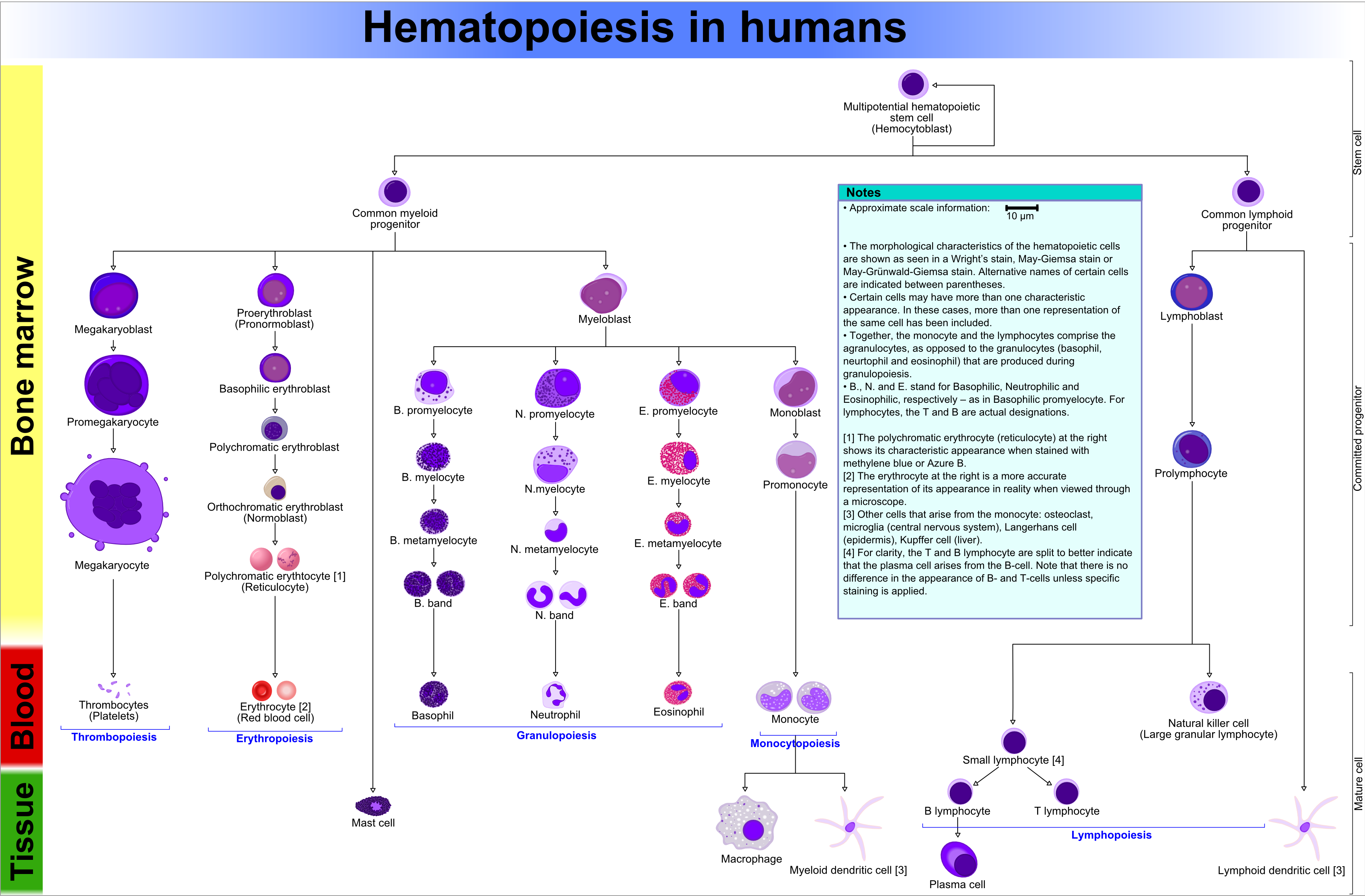
The process of haematopoiesis occurs in several stages, and is controlled by at least 11 growth factors. The first stage involves the differentiation of a pluripotential stem cell into a committed progenitor, which is followed by maturation of committed progenitors in distinct pathways.


The common myeloid progenitor can generate:
● proerythroblasts (pronormoblasts) → erythropoiesis
● myeloblasts → granulopoiesis
● monoblasts → monocytopoiesis
● megakaryoblasts → thrombopoiesis
The common lympoid progenitor can generate:
● lymphoblasts → lymphopoiesis
Committed progenitor stage to mature cell : granulopoiesis
↓
myeloblast
↓
B/E/N promyelocyte
↓---↓---↓
B/E/N myelocyte
↓---↓---↓
B/E/N metamyelocyte
↓---↓---↓
B/E/N band
↓---↓---↓
basophil, eosinophil, neutrophil
↓ -----------------------
mast cell -----------------------
Committed progenitor stage to mature cell : lymphopoiesis
↓
lymphoblast
----------------------------------------↓ rearrangements H: D-J → H: V-DJ
prolymphocyte
-----------------↓ rearrangements L: V-J --------------------------↓
small lymphocyte------or----- natural killer cell (large granular lymphocyte)
------------↓ IgM→IgD ---------↓------------------------------------ ↓
------B lymphocyte--or-- T lymphocyte
------------↓----------------------------------------------------------- ↓
--------plasma cell------------------------------------------lymphoid dendritic cell
Development of mature B lymphocytes from multipotent progenitors requires the coordinated activities of a number of transcriptional regulatory proteins, including EBF, Pax-5, and E2A.
E2A proteins function in early B lineage development to regulate B lineage-specific gene expression as well as B cell survival. E2A-encoded proteins are involved in the differentiation of a number of cell types, and they are especially important in lymphocyte development.
The E2A gene encodes E47 and E12, which are basic-helix-loop-helix (bHLH) transcription factors that bind DNA either as homodimers or as heterodimers with other bHLH proteins. Such bHLH DNA binding activity in the B-lineage comprises E47 homodimers. Development of thymocytes mainly involves heterodimers of E47 and a related bHLH protein, HEB. Thymocytic E2A protein expression is required to initiate T-cell differentiation. During the development of thymoctyes, E-proteins and their antagonists, Id2 and Id3, regulate T-lineage specific gene expression and TCR rearrangement. E2A and Id proteins block thymocytic maturation in the absence of pre-TCR expression, and pre-TCR signaling acts to promote development in part by inhibiting E2A activity. [l]
Committed progenitor stage to mature cell : monocytopoiesis
↓
monoblast
↓
promonocyte
↓
↓ ----↓
macrophage or myeloid dendritic cell
Committed progenitor stage to mature cell : erythropoiesis
↓
proerythroblast
↓
basophilic erythroblast
↓
polychromatic erythroblast
↓
polychromatic erythrocyte (reticulocyte)
↓
erythrocyte (RBC)
Committed progenitor stage to mature cell : thrombopoiesis
æ Archaea & Eubacteria ¤ Cancer סּ Cell Biology ~ Chemistry of Life Diagrams & Tables ♦ Enzymes ₪ Evo Devo ○ Molecular Biology φ Molecules ō Organics ››› Pathways ▫▫ Virus
▲ Top ▲


Chemicals used in industries gives me Leukemia and it's all started when I wanted to get off my job to get another job that when I got diagnose, at that very point I was so scared to die because it has infected my blood cells also I was prescribed drugs like Cyclophosphamide,Busulfan,Bosutinib,Cytarabine, Cytosar-U (Cytarabine),Dasatinib in all that was just to keep me waiting for my dying day. I got inspired by what I read from a lady on blog spot on how Dr God hands cure her HIV/Aids with herbal medicine then they were lettered below that says he can cure Cancer so I pick his contact on the testimony she wrote then I emailed Dr God hands hopefully he replied swiftly to my mail then I purchased his Herbal medicine also it was shipped to me here in Texas, I went to pick it at post office so he instructs me on how the treatment will take me three weeks to cure my Leukemia Disease, Joyfully I was cured by this Dr God hands Herbal Medicine.
I will advise you too to give a try to Dr God hands Herbal Medicine with the following diseases that he can help you cure permanently such diabetes, Herpes, HIV/Aids, Bladder Cancer, Breast Cancer,Parkinson's disease,Lung Cancer, Breast Cancer, Colo-Rectal Cancer, Blood Cancer, Prostate Cancer,Arthritis,Fibromyalgia,Adrenocortical carcinoma. Asthma, Cold, Glaucoma, Cardiovascular disease, Lung disease, Enlarged prostate, Alzheimer's disease, Dementia, Vaginal Cancer, Kidney Cancer, Lung Cancer, Skin Cancer, Uterine Cancer, Prostate Cancer, Colo_Rectal Cancer, Leukemia Cancer, Hepatitis, Brain Tumors, Love Spell, Infertility, Hpv. GoodLuck, XoXo****Dr Owo Ibuku Also known as Doctor God hands Contact Information:::Email (doctorgodhands@gmail.com) WhatsApp-(+2349057214220)